


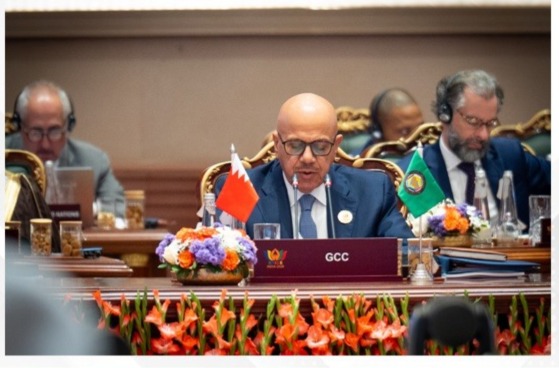
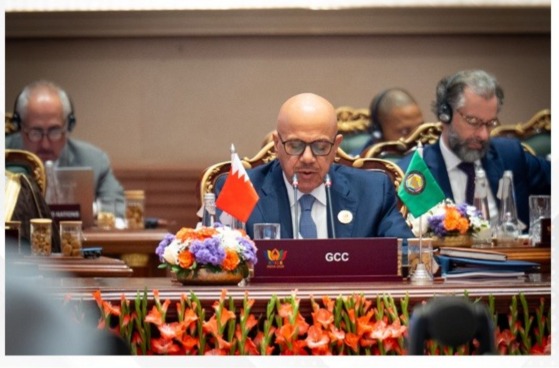
New Delhi : Assigned by His Majesty King Hamad bin Isa Al Khalifa, Chairman of the Supreme Council of the Gulf Cooperation Council in its current session, Dr. Abdullatif bin Rashid Al Zayani, Minister of Foreign Affairs, participated in the expanded dialogue session of the 18th BRICS Summit, held in New Delhi under the theme “Resilience, Innovation, Cooperation and Sustainability,” and chaired by Narendra Modi, Prime Minister of the Republic of India.
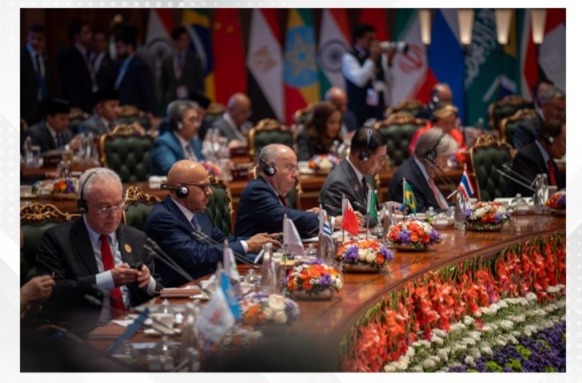
The summit was attended by a number of heads of state, heads of government, and foreign ministers of BRICS member states, partner countries, and invited countries.
In his address, the Minister conveyed the greetings of His Majesty the King, along with His Majesty’s wishes for the success of the summit.
Dr. Al Zayani said that the GCC countries share relations with the members of the Group, reflected in existing partnerships in the fields of energy, digital connectivity, food security, and logistics, as well as a shared aspiration to strengthen cooperation and expand mutual investment.
The Minister added that there are growing opportunities for practical cooperation with the Group’s countries in areas including the digital economy, financial technology, artificial intelligence, clean energy technologies, and food supply chains, with a view to translating dialogue into tangible benefits for the peoples of the participating countries and the Global South.
Dr. Al Zayani affirmed that economic resilience is not built on innovation alone, but also on the security of the vital routes through which trade flows. He noted that the Arabian Gulf represents a key link in these routes, with vital maritime waterways, including the Strait of Hormuz, Bab Al Mandab, and the Red Sea, serving as essential channels for the movement of energy, food, and goods, from which the countries of the Group benefit. This underscores that safeguarding their security and stability is a shared interest of both the Group and the international community.
The Minister stressed that recent events have demonstrated that any disruption to a strategic maritime corridor extends beyond its geographical boundaries, affecting energy prices, transportation and insurance costs, supply chains, food security, and the ability of the least developed countries to address cross-border crises. He affirmed that safeguarding freedom of navigation and the smooth flow of international trade, in accordance with international law and rules, foremost among them the United Nations Convention on the Law of the Sea, is a shared responsibility that ensures these waterways remain safe, open, and free from obstruction or restrictions.
Dr. Al Zayani said that ensuring the security and stability of these corridors cannot be separated from the security and stability of the region. He explained that the GCC countries believe that sustainable security cannot be achieved through military means alone, but also through dialogue and diplomacy, respect for the sovereignty and territorial integrity of states, non-interference in their internal affairs, and the peaceful settlement of disputes.
In this context, he highlighted the role of multilateral action, including BRICS, in promoting dialogue and cooperation, and addressing shared challenges in accordance with the principles of the Charter of the United Nations and international law. From Palestine to Yemen, Lebanon, Syria, and Sudan, there remains a need for just political solutions that preserve the sovereignty of these countries, strengthen their security and stability, support recovery and reconstruction, and pave the way for lasting peace that leads to development and prosperity.
He added that the challenges facing the world today require collective action that transforms dialogue into partnerships, innovation into development, and stability into shared prosperity, affirming that the GCC countries will remain committed partners in every international effort that promotes peace, security, and stability and builds a safer and more sustainable future founded on dialogue, cooperation, and mutual benefit.
Bahrain’s delegation to the summit included Mr. Abdulrahman Mohammed Al Gaoud, Ambassador of the Kingdom of Bahrain to the Republic of India, Ambassador Saeed Abdulkhaliq Saeed, Chief of the Coordination and Follow-up Sector at the Ministry of Foreign Affairs, and the accompanying delegation of the Minister of Foreign Affairs.
