



Manama : The Ministry of Justice, Islamic Affairs and Endowments has upgraded its service for monitoring minors’ ongoing education requirements. The aim is to organise and simplify the payment of regular school fees for students eligible for ongoing payments.
The service-level agreement has been reduced by at least 25%, cutting processing time from 14 working days to seven. Required documents have been reduced by 50%, while the service is now provided automatically, service information has been standardised across all channels, required approvals have been reduced by 25%, and application forms have been made available electronically.
Basma Mohammed Al Khayyat, Director of the Minors’ Affairs and Funds Directorate at the Ministry of Justice, Islamic Affairs and Endowments, said the launch is part of the ministry’s efforts to develop more proactive services focused on beneficiaries’ needs and to complete procedures on time. This will improve service efficiency and the experience of those under guardianship and those responsible for their affairs.
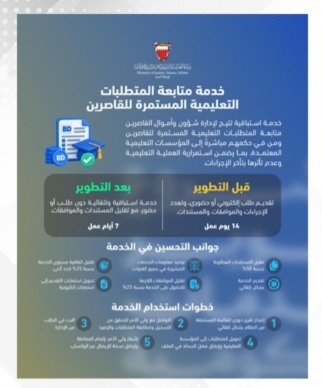
She added that the service proactively tracks eligible cases and payment due dates. The ministry contacts the educational institution to obtain the invoice and confirm that the student remains enrolled, while notifying the parent or person responsible for the student to begin the payment process before completing the approval and transfer procedures.
The service aims to proactively track school fee due dates and coordinate directly with educational institutions to confirm students’ continued enrolment and obtain updated invoices. It then completes the approval process and transfers the fees directly to the educational institution, helping ensure payments continue while reducing the procedures required from parents or those responsible for the student.
The service also allows more than one student to be included in a single application, with the fees for each student specified separately. This helps simplify the process. At its current stage, the service applies to educational institutions in the Kingdom of Bahrain.
As part of ongoing government efforts to improve and redesign government services, more than 1,300 government services have been documented, translated and published. Some 800 of these services have undergone development and redesign across various government sectors, based on suggestions and feedback submitted through the national Tawasul suggestions and complaints system, investor feedback and mystery shopper reports evaluating government services. Guidance manuals and service-level agreements have also been introduced to improve efficiency, service quality and the beneficiary experience, while supporting Bahrain’s government digital transformation.
