


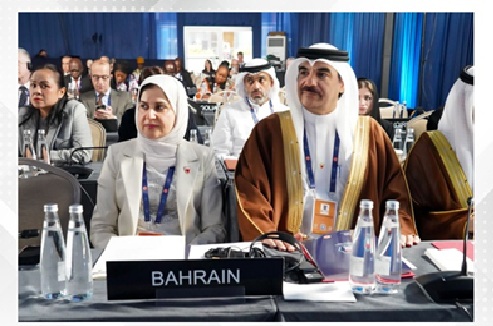
Istanbul : Kareema Mohammed Al Abbasi, Secretary General of the Shura Council, delivered a speech at the meeting of the Association of Secretaries General of National Parliaments, which discussed the use of artificial intelligence in parliaments, on the sidelines of the 152nd IPU General Assembly, held in Türkiye.
Al Abbasi affirmed that the use of artificial intelligence applications within the General Secretariat of the Council enhances the digital transformation process and improves the quality of legislative decision-making, in line with the Kingdom of Bahrain’s national direction towards investing in technological advancement, and in accordance with the visions of His Majesty King Hamad bin Isa Al Khalifa.
The Secretary General explained that the General Secretariat of the Shura Council, under the directives of Ali bin Saleh Al Saleh, Chairman of the Shura Council, views artificial intelligence as a transformative path that is reshaping parliamentary work mechanisms by developing an integrated knowledge environment that contributes to improving the quality of legislative decision-making.
She noted that among the key applications developed is the virtual assistant “Sanad”, which has brought a qualitative shift in dealing with legislative information, enabling knowledge access through direct interaction with databases instead of traditional search methods. This has reduced response time to legislative inquiries and enabled tracking of the legislative process of draft laws, linking them with previous records, recommendations of the legislative observatory, and government work programme themes.
Al Abbasi added that an automated subject classification feature has also been implemented, improving search quality, reducing document retrieval time, and enhancing interconnection between systems, moving beyond individual interpretation.
The Secretary General noted the adoption of smart documentation through speech-to-text conversion with support for the Bahraini dialect, which has improved the preparation of parliamentary records, making them faster, more accurate, and easier to search and analyse.
She also highlighted the activation of machine and real-time translation within work systems and devices used by Shura Council members, which has enhanced interaction with foreign delegations without delay and supported the Council’s openness through multilingual translation across digital platforms.
Al Abbasi explained that the integration of Microsoft Copilot technologies into the work environment has contributed to the development of reports, presentations, and financial analysis, reducing human errors, easing routine workloads, and improving administrative productivity.
The Secretary General further noted that the Council has also benefited from the use of artificial intelligence in software development and cybersecurity, enhancing development speed and accuracy, improving digital stability, and contributing to early detection of security risks.
She confirmed that these initiatives form part of an integrated institutional approach, noting that in 2025 the General Secretariat launched a competition for Bahraini youth on digital innovation in parliamentary work, which generated innovative ideas evaluated by specialists, with the best of them selected for implementation.
Al Abbasi noted that this progress has been reflected in the Council’s digital performance indicators, with it ranking first in the Arab world and 13th globally in the Parliamentary Digital Maturity Index 2024 issued by the Inter-Parliamentary Union, reflecting the maturity, integration, and effectiveness of its digital systems.
The Secretary General emphasised the importance of transitioning parliamentary work from traditional systems to a data- and AI-based digital environment that supports decision-making, enhances transparency, and preserves institutional memory, while reaffirming the central role of the human element in guidance, oversight, and decision-making.
