


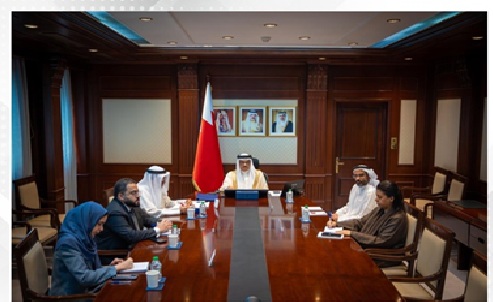
Manama : As the Kingdom of Bahrain assumes the presidency of the Arab League Ministerial Council at its 165th session, Dr. Abdullatif bin Rashid Al Zayani, Minister of Foreign Affairs, chaired the Council’s virtual meeting, with the participation of Foreign Ministers of the Arab states, and Ahmed Aboul Gheit, Secretary General of the League of Arab States.
The meeting discussed the repercussions of the blatant Iranian attacks against the Gulf Cooperation Council (GCC) countries and other Arab states, the resulting loss of lives and property, as well as the implications of restricting international navigation in the Strait of Hormuz on energy security, food supplies, and global trade.
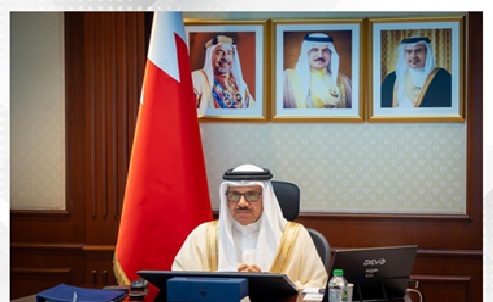
In his opening remarks, Dr. Al Zayani stated that this session is being held amid highly delicate and sensitive regional and international circumstances, which require Arab states to enhance coordination and joint action in a manner that serves the interests of their peoples. He reaffirmed the Kingdom of Bahrain’s commitment to supporting joint Arab action and strengthening cooperation and solidarity among Arab states to address current challenges and safeguard Arab national security and interests.
He expressed appreciation for the constructive and positive engagement of Arab states during the extraordinary Ministerial Council session held on 8 March, convened in response to the treacherous Iranian attacks, and for the resolution adopted, which affirmed the right of affected states to self defense, individually or collectively, in accordance with Article 51 of the United Nations Charter. He also reiterated support for recourse to international institutions, including the United Nations Security Council and General Assembly, and for all efforts aimed at securing international resolutions condemning these attacks.
The Minister noted that the Kingdom of Bahrain, on behalf of the GCC states and the Hashemite Kingdom of Jordan, submitted a draft resolution to the UN Security Council, which was adopted on 11 March 2026 as Resolution 2817, reflecting the collective will of the international community to uphold state sovereignty and maintain international peace and security. He expressed pride in the broad support the resolution received from 136 UN member states, as a clear indication of the international community’s commitment to upholding sovereignty and addressing threats to regional and global stability.
The Foreign Minister added that the adoption of Resolution 2817, along with wide international solidarity, underscores the importance of Arab diplomatic action in international fora, particularly the United Nations. He pointed out that Iran has not complied with the resolution, which called for an immediate cessation of attacks, but has instead persisted in its escalation through ballistic missiles and drones targeting civilians and civilian infrastructure, including airports, ports, hotels, energy and industrial facilities, food security services, service sites, residential areas, and diplomatic and consular missions, resulting in significant loss of life and property.
He also commended the resolution adopted by the Human Rights Council in Geneva concerning the human rights implications of the unjustified Iranian attacks targeting several GCC states and the Hashemite Kingdom of Jordan, which was adopted by consensus with the support of 106 sponsoring countries.
Addressing maritime security, the Minister highlighted Iran’s hostile practices in restricting navigation in the Strait of Hormuz, describing them as a clear violation of international law, including the United Nations Convention on the Law of the Sea, and a serious threat to international navigation, energy supplies, global trade, the interests of all countries, as well as in addition to its deliberate violation of the clear and explicit provisions of resolution 2817. He noted that the Kingdom of Bahrain is working with relevant partners to prepare a draft UN Security Council resolution aimed at ensuring freedom of navigation in this vital waterway and obligating Iran to comply with international law and Security Council resolutions related to the Strait.
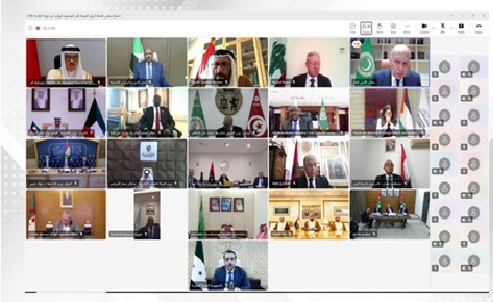
The Foreign Minister emphasised that the current phase, with its complexities and challenges, requires all Arab states to strengthen unity, consolidate ranks, and act with a spirit of collective responsibility to effectively address shared challenges. He stressed the importance of coordinating Arab positions in international forums, particularly the United Nations, as a pressing necessity to enhance Arab presence and influence globally and to defend Arab causes, foremost among them the Palestinian cause. He reaffirmed the Kingdom of Bahrain’s commitment, in its capacity as the Arab member of the Security Council, to defend Arab interests and amplify their voice at the international level.
At the conclusion of the meeting, the Arab Ministerial Council issued a joint declaration reaffirming its full condemnation, in the strongest terms, of the deliberate and aggressive Iranian attacks carried out using ballistic missiles and drones, which targeted civilian areas, critical infrastructure and civilians, causing significant loss of life and property and spreading fear among citizens and residents in the targeted countries. The Council described these acts as a blatant violation of state sovereignty, a threat to security, and an attack on civilian populations.
The Council reaffirmed the right of affected states to self defense, individually or collectively, in accordance with Article 51 of the United Nations Charter, and expressed full solidarity with the countries targeted by these treacherous attacks, on the basis that Arab national security is indivisible, reiterating its unwavering support for the sovereignty, independence, and territorial integrity of all Arab states.
The Council also expressed its support for all efforts and measures taken by the affected countries to defend their territories, ensure security, and protect their citizens and residents, including their right to respond to these attacks. It further expressed full confidence in their ability to repel such aggression and commended the readiness and effectiveness of their armed forces and air defense systems in confronting these unlawful attacks.
