


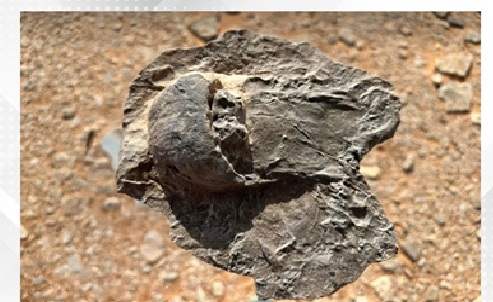
Riyadh : The Royal Commission for AlUla announced the documentation and international publication of a scientific discovery involving rare horseshoe crab fossils dating back approximately 465 million years, as part of a peer-reviewed study published in Gondwana Research, an international journal specialising in geological sciences.
The fossil discovery has been published internationally for the first time. The fossils were found in AlGharameel Nature Reserve in AlUla and contribute to the scientific understanding of the region’s natural and geological history.
The fossils date to the Middle Ordovician period, approximately 485–444 million years ago, placing them among the oldest known horseshoe crab fossils worldwide. Researchers noted their exceptionally large size compared with other specimens from the same period. All fossils were found preserved upside down, a mode of preservation not previously recorded, alongside trace fossils indicating attempts by the organisms to return to their natural position. These features provide rare evidence of early behavioural patterns.
Geological stratigraphic analysis indicates the recurrence of strong seasonal storms during that period, suggesting that the organisms gathered in shallow coastal environments affected by such events. These conditions contributed to their preservation within sedimentary deposits and provide insight into AlUla’s ancient environment as a coastal region.
The discovery also represents a previously unclassified species. Research was conducted in two phases in collaboration with a scientific team led by Dr. Russell Bicknell of Flinders University in Adelaide. A second research phase, scheduled for the first half of 2026, will include the collection of additional samples and further study ahead of formal scientific classification. The fossil specimens have been preserved within the commission’s museum collections to support future research and public engagement.
The commission said the findings reflect its efforts to support scientific research, strengthen international collaboration, and develop research and educational programmes related to natural heritage. The discovery aligns with the objectives of Saudi Vision 2030 to enhance the Kingdom’s global presence in scientific and cultural knowledge.
