


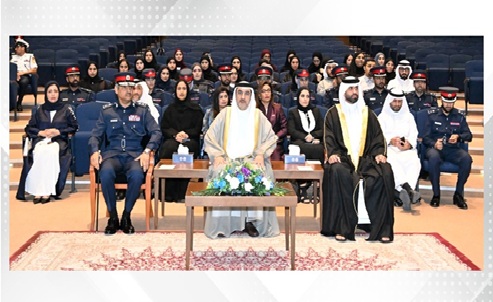
Manama : The Information and eGovernment Authority (iGA), in cooperation with the Royal Academy of Police (RAP), celebrated the winning participant teams from public and private university students who won the 2025 AI GameDay Challenge. The event was organised in partnership with the United Nations Development Programme (UNDP) and Amazon Web Services (AWS), with support from stc Bahrain. The challenge is in line with efforts by the iGA to advance digital innovation, build AI and cloud computing talent, and prepare future generations with knowledge and hands-on skills.
Mohammed Ali Al Qaed, Chief Executive of the iGA; Major General Fawaz Hasan Al Hassan, Commandant of the Royal Academy of Police; university representatives; sponsors; and participating students attended the event.
The challenge featured strong participation from university students across the Kingdom, reflecting a growing interest in digital innovation. A total of 17 teams took part, with each team consisting of three to five students. Participants demonstrated impressive creativity and analytical thinking, highlighting the ability of Bahraini youth to work with advanced technologies and keep pace with rapid advancements in AI and cloud computing.
On this occasion, Mohammed Ali Al Qaed, Chief Executive of the iGA, said that the AI GameDay Challenge is a leading national platform for developing students’ skills in innovation and problem-solving through the adoption of AI and cloud technologies. He said the initiative embodies the Kingdom’s senior leadership’s vision to empower national youth in technology and to contribute actively to building the “digital future” and driving innovation.
He added that it also reflects the directives of General Shaikh Rashid bin Abdullah Al Khalifa, Minister of Interior and Chairman of the Ministerial Committee for Information and Communication Technology (MCICT), to empower young Bahrainis with valuable skills to prepare them for the future digital landscape and enable them to contribute to the Kingdom’s digital transformation.
Al Qaed highlighted that the initiative falls within a broader national vision to invest in the development of young minds. It complements a digital transformation journey that began with the launch of the first eGovernment strategy in 2007, followed by the National Digital Economy Strategy in 2023, which focused on the adoption of innovative and advanced technologies.
He noted that the government is committed to deploying AI technologies through the formation of a specialised committee to research and study AI adoption priorities, resulting in the development of the Guiding Manual on the Ethics of Artificial Intelligence Use in the GCC, endorsed regionally, as well as the establishment of the Innovation and Advanced Technologies Directorate within the iGA.
He emphasised that building national capabilities and developing technical skills is a fundamental pillar in supporting the Kingdom’s readiness for the next growth phase.
He underscored key national programmes such as the Technical Development Programme, which has resulted in 114 participants securing jobs in the public and private sectors, the AI Talent Programme, and the AI GameDay Challenge. He noted that the high competitiveness and innovation shown by the participants reflects the ambition and determination of Bahrain’s youth and their readiness to adopt the latest technologies and apply them to impactful solutions.
He congratulated the winning teams and all participants, expressing that the initiative provides a motivating practical environment that turns knowledge into real applications and helps shape a generation capable of confidently leading Bahrain into the digital age while supporting innovation and national transformation.
Major General Al Hassan emphasised that the Academy’s hosting of the challenge is in line with Bahrain’s senior leadership’s approach to empowering Bahraini youth and developing their capabilities in innovation and technology.
He said the Academy prioritises social responsibility by providing a supportive educational and training environment for national initiatives and equipping students with future-ready skills.
He added that the Academy looks forward to expanding its partnership with the iGA to support broader innovation and digital transformation efforts, in cooperation with relevant national and international entities, to enhance the quality of programmes and cultivate a generation capable of innovation and contributing to shaping the future.
Shaikh Zeyad bin Faisal Al Khalifa, stc Bahrain Chief Government Affairs Officer, expressed appreciation for the AI Challenge, noting that empowering young Bahrainis with the skills needed to work with advanced technologies is a core part of stc Bahrain’s commitment to the community.
He said stc Bahrain’s participation reflects its role in developing national talent and equipping students with knowledge and skills in AI and cloud computing, helping to foster innovation and expand opportunities for professional growth.
He added that the success of the competition demonstrates strong collaboration between the iGA, RAP, and partners such as stc Bahrain, reflecting a unified effort to advance the Kingdom’s digital landscape. He thanked the organisers and participants for their efforts and emphasised stc Bahrain’s continued support for initiatives that prepare a new generation capable of shaping Bahrain’s future.
The winning teams were awarded cash prizes supported by stc Bahrain: BD1,500 for first place (M&M’s Team), BD1,000 for second place (Cloud Unicorns Team), and BD500 for third place (Tech Team).
Teams placing fourth through eighth received the opportunity to enrol in specialised training courses through the UNDP Arab Knowledge Project, aimed at encouraging the development of participants’ practical skills and enhancing their ability to innovate in line with labour-market needs and emerging ICT trends.
The competition included virtual training sessions held two days prior to the challenge to raise students’ technical readiness and help them confidently tackle the tasks ahead.
Led by expert trainers, the sessions provided students with the preparation needed to create innovative solutions during the competition.
The challenge consisted of three main stages, each designed to give students hands-on experience in using AI to create practical solutions.
The first stage, Mystery Code, required students to create an interactive application that transforms any sentence or description entered by a user into generated text and images within seconds. This enabled participants to see the immediate creative potential of AI and strengthened their ability to design engaging, user-friendly digital experiences.
The second stage, Unicorn Voice, introduced students to techniques for analysing long calls and automatically extracting key information without listening to lengthy recordings. This enhanced their understanding of AI’s role in improving service quality and helping organisations deploy their data with greater speed and accuracy.
The third stage, Unicare, focused on the healthcare information sector. Students analysed complex medical data in smart and efficient ways to make information quicker and easier to access. This provided practical experience in building solutions that enhance medical workflows and support data-driven decision-making.
Together, the three stages offered students a comprehensive practical experience that enabled them to address real needs, strengthened their technical and analytical skills, and prepared them to play an active role in Bahrain’s national digital transformation.
