


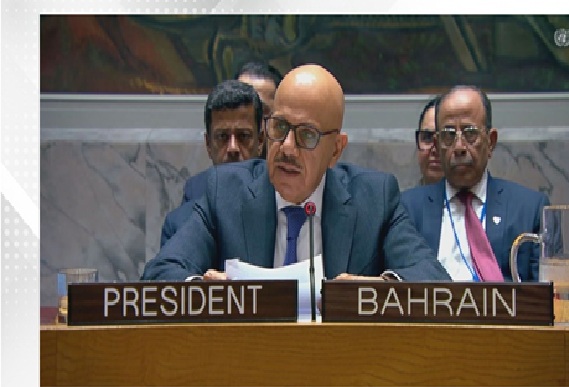
New York : As part of the Kingdom of Bahrain’s presidency of the United Nations Security Council for the month of April, and its chairmanship of the Council of the League of Arab States at the ministerial level during its current session, His Excellency Dr. Abdullatif bin Rashid Al Zayani, Minister of Foreign Affairs, participated in the Security Council session on cooperation between the League of Arab States and the United Nations, held today at the Council’s headquarters under the agenda item: “Cooperation between the United Nations and regional and subregional organizations in maintaining international peace and security.”
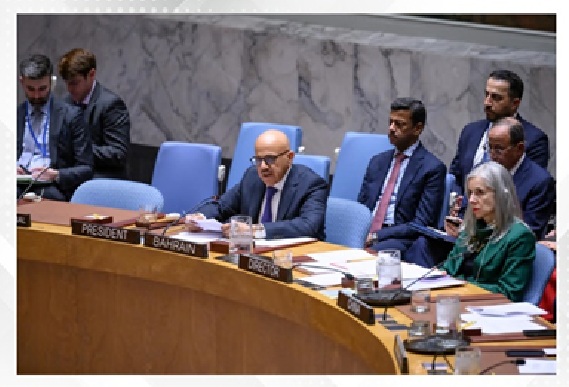
The session was attended by Khaled Khiari, Assistant Secretary-General for the Middle East, Asia and the Pacific, Europe, and the Americas, and Ahmed Aboul Gheit, Secretary-General of the League of Arab States.
At the outset of the session, the Minister of Foreign Affairs delivered a statement affirming that Arab issues continue to occupy a prominent place on the Security Council’s agenda, and that strengthening cooperation and coordination between the United Nations and the League of Arab States is no longer merely a priority, but an urgent necessity and a political and legal obligation to uphold the principles of the UN Charter, prevent the worsening of crises, and promote regional stability.
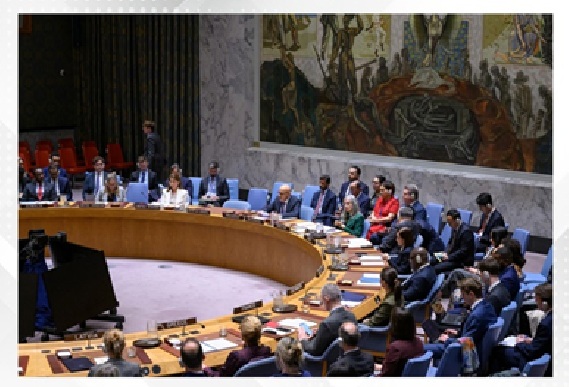
He said that today’s session comes amid the current challenges facing our region, where a dangerous escalation is unfolding as a result of the ongoing unlawful Iranian attacks against a number of Arab states, including the Kingdom of Bahrain, in a flagrant violation of sovereignty and a direct threat to regional and international peace and security.
He noted that Security Council Resolution 2817, which was sponsored by 136 member states, and the United Nations Human Rights Council resolution adopted on 25 March 2026 by consensus with the sponsorship of 115 member states, reflected a firm international position condemning these unjustified attacks, calling on Iran to cease them immediately, and emphasizing the need to protect civilians and civilian infrastructure while ensuring freedom of navigation. He stressed the importance of the Security Council continuing to discharge its responsibilities in addressing these attacks, ensuring accountability, and preserving peace and stability in the region.
He added that the Iranian attacks in the Arabian Gulf extend beyond the borders of the targeted states and affect the security and stability of the region as a whole, calling on Iran to cease supporting and arming its affiliated militias in Arab states, and to refrain from any practices that threaten freedom of navigation in the Strait of Hormuz and Bab Al-Mandab, in line with international law and in a manner that safeguards international peace and security.
The also called on the international community to take appropriate measures to ensure Iran’s compliance with international law and relevant Security Council resolutions, including Resolution 2817, and to cease all actions that undermine regional peace and stability, thereby helping to create an environment conducive to sustainable political solutions and strengthening collective security in our region.
Dr. Al Zayani affirmed that Arab states have strengthened regional solidarity and expanded their international partnerships, and that their role in supporting efforts to resolve crises through peaceful means has become increasingly evident. This, he noted, gives practical effect to Chapter VIII of the United Nations Charter as a framework for enhanced cooperation between the UN and regional organizations, and confirms that achieving sustainable peace requires close integration between international legitimacy and regional ownership.
The Minister stressed the importance of continuing to develop the partnership between the United Nations and the League of Arab States in a manner that enhances both sides’ ability to respond effectively to current challenges and contributes to consolidating the foundations of regional peace and stability. He underscored the need to intensify efforts aimed at conflict prevention, de-escalation, and the advancement of political initiatives leading to lasting peaceful settlements, while prioritizing the protection of civilians and humanitarian response. This includes ensuring respect for international humanitarian law, the safe and unhindered delivery of humanitarian assistance, and strengthening the role of UN agencies in fulfilling their humanitarian responsibilities. He added that this role is of particular importance in Palestine, where the United Nations, through its bodies and agencies, remains a fundamental pillar in providing humanitarian support, protecting civilians, and maintaining the presence of the international community in efforts toward a just and comprehensive settlement of the Palestinian issue on the basis of the two-state solution and relevant international legitimacy resolutions.
He also emphasized the importance of intensifying international efforts to end the war in the Gaza Strip and achieve a sustainable ceasefire, in line with Security Council Resolution 2803, the plan of President Donald Trump of the United States to end the conflict in Gaza, and the outcomes of the first meeting of the “Peace Council,” as a pivotal platform for dialogue, action, and implementation that contributes to coordinating international efforts for Gaza’s reconstruction, supporting early recovery, and strengthening long-term stability.
He further stressed the importance of advancing a credible political track that leads to a just and comprehensive peace for the Palestinian cause, building a future founded on security, hope, and opportunity, and addressing the root causes of conflicts in a way that lays the foundations for genuine and lasting peace in the Middle East.
The Minister s also affirmed the Kingdom of Bahrain’s commitment to continuing to play its role in a constructive and responsible spirit throughout its membership in the Security Council, in a manner that strengthens regional and international peace and stability and contributes to consolidating an international order based on law, justice, and cooperation.
