


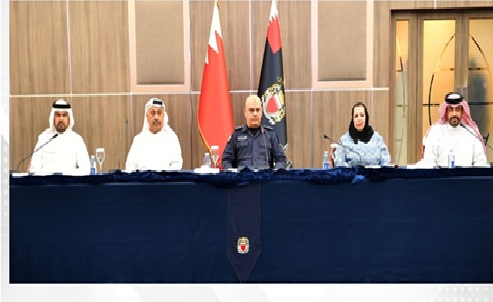
Manama : Lieutenant General Tariq bin Hassan Al Hassan, Chief of Police and Chairman of the National Civil Emergency Management Committee, chaired an extraordinary meeting of the committee, attended by representatives of the relevant member entities, to review the workflow of the National Civil Emergency Management Centre amid the Iranian aggression against the Kingdom of Bahrain and the current regional developments.
Lt-Gen Al Hassan commended the royal directives of His Majesty King Hamad bin Isa Al Khalifa, and the order of His Royal Highness Prince Salman bin Hamad Al Khalifa, the Crown Prince and Prime Minister, to compensate citizens for damage to their homes and vehicles resulting from the aggression. He noted that these directives reflect the leadership’s commitment to the welfare of citizens and its dedication to supporting them and meeting their needs under all circumstances.
The Chief of Police also commended the instructions of General Shaikh Rashid bin Abdullah Al Khalifa, Minister of Interior and Chairman of the Civil Defence Council, and his support for risk management through a strategic approach that ensures the sustainability of key services, the preservation of strategic stocks, and the review of comprehensive national plans in this regard.
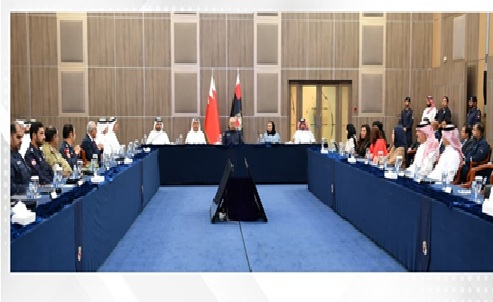
During the meeting, he underscored the importance of the institutional integration led by the National Civil Emergency Management Centre, stressing its role in unifying national efforts and enhancing coordination among the relevant authorities to improve response efficiency, crisis management, and the ability to meet the needs of citizens and residents.
The meeting reviewed the overall situation, including updates to the dashboard and daily data, to support swift decision-making based on accurate analysis of developments and indicators.
The meeting also covered topics to ensure comprehensive protection, including field readiness and the strengthening of response capabilities, as well as the sustainability of services and infrastructure through the preparation of integrated plans to ensure food, water and medical security, the efficiency of the energy and electricity sector, and the resilience of communications networks and warning systems, in addition to reviewing the approved plans with the various relevant institutions.
The committee approved expanding awareness and media programmes through the National Civil Protection Platform, alongside implementing field exercises, while emphasising the continuation of regional and international coordination and cooperation with organisations and emergency operation rooms to exchange expertise and information.
The committee affirmed that work is continuing around the clock to monitor the event log and periodically update response plans to enhance the readiness of the national system and ensure the protection of lives and property and the safeguarding of national security.
