


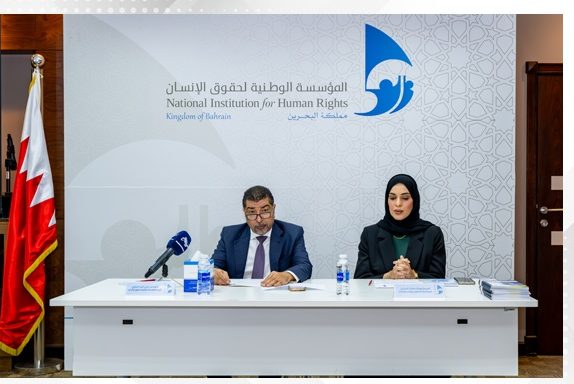
Manama : The National Institution for Human Rights (NIHR) has launched its new 2027–2030 strategy at a press conference held at its headquarters in Seef District, attended by media representatives.
The launch coincides with the 17th anniversary of the Institution’s establishment and marks a step towards developing its institutional performance and strengthening its independent role in protecting and promoting human rights in the Kingdom of Bahrain. The strategy sets out four main strategic objectives addressing human rights priorities and needs over the next four years.
In his address, Ali Ahmed Al Derazi, NIHR Chairman, said the new strategy marks an important stage in the Institution’s work and reflects its commitment to further developing its tools and mechanisms while building on achievements made in previous years.
Since its establishment in 2009, he said, the Institution has worked to consolidate its role as an independent national body exercising its mandate in accordance with its founding law and the Paris Principles. Its work covers monitoring, receiving complaints, conducting field visits, submitting recommendations, promoting human rights awareness and strengthening partnerships.
Al Derazi explained that the strategy was developed following an assessment of the previous strategy’s outcomes, an analysis of the Institution’s work and human rights needs, and consultations with partners and stakeholders. This approach aims to ensure that programmes and initiatives deliver tangible results and sustainable impact.
He noted that 2026 represented a transitional phase during which priorities had to be reassessed and monitoring and follow-up efforts intensified in response to developments and exceptional circumstances in the Kingdom. This necessitated extending the previous strategy ahead of the new strategy’s implementation in early 2027, for a four-year period.
The Chairman stressed that identifying strategic priorities does not limit the scope of the Institution’s work. He affirmed that it would continue to exercise all its statutory mandates in protecting and promoting human rights, while maintaining its independence in carrying out its oversight, advisory and awareness-raising functions. These efforts contribute to developing Bahrain’s human rights framework and strengthening cooperation with national entities and relevant partners.
For her part, Rawdha Salman Al Aradi, Chairperson of Complaints, Monitoring and Follow-up Committee, outlined the strategy’s four objectives.
The first focuses on consolidating a human rights culture, strengthening national partnerships and building institutional capacity, particularly among personnel of law enforcement bodies, correctional institutions and entities concerned with protecting rights and freedoms.
The second aims to empower civil society organisations and strengthen their capacities in monitoring, report writing and engagement with regional and international human rights mechanisms. It also seeks to raise awareness of digital rights and data protection, while addressing challenges associated with cybersecurity and artificial intelligence.
The third objective focuses on promoting respect for and protection of the rights of groups requiring particular care, including women, older persons, persons with disabilities and migrant workers, through monitoring challenges and developing relevant national practices.
The fourth seeks to promote and protect children’s rights, enable their effective participation at the national and international levels, and protect them from all forms of violence, exploitation and abuse.
Al Aradi affirmed that implementation of these objectives would go hand in hand with the Institution’s continued exercise of its statutory mandates, including receiving complaints, monitoring, conducting field visits and submitting recommendations, thereby enhancing its effectiveness and achieving a sustainable human rights impact.
The press conference concluded with a question-and-answer session, during which media representatives raised queries about the new strategy’s objectives, priorities and implementation mechanisms. The Institution outlined its main priorities for the coming phase and highlighted the importance of partnerships and cooperation with relevant entities in strengthening national efforts to protect human rights and promote respect for them in Bahrain.
