


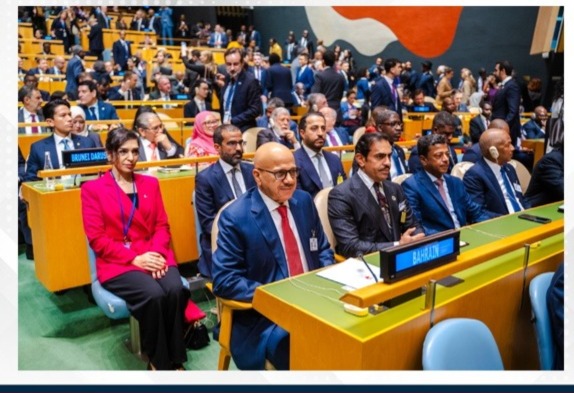
New York : Dr. Abdullatif bin Rashid Al Zayani, Minister of Foreign Affairs, headed Bahrain’s delegation participating in the opening session of the general debate of the 81st session of the United Nations General Assembly, held under the theme “Restoring Trust, Managing Transformation: A United Nations That Delivers for All”.
The session was presided over by Dr. Khalil Rahman, President of the 81st session of the UN General Assembly, with the participation of António Guterres, Secretary-General of the United Nations.
Bahrain is participating in the session as a non-permanent member of the UN Security Council for the 2026–2027 term, reaffirming its commitment to the UN Charter, multilateral action, international peace and security, and efforts to address shared global challenges.
Bahrain’s delegation included Shaikh Abdullah bin Rashid Al Khalifa, Ambassador to the United States; Ambassador Jamal Fares Al Rowaiei, Permanent Representative of Bahrain to the United Nations in New York; Dana Emad Hamza, Assistant Undersecretary for Sustainable Development at the Ministry of Sustainable Development; Ambassador Shaikh Abdullah bin Ali Al Khalifa, Director-General of Bilateral Relations at the Ministry of Foreign Affairs; and Ambassador Saeed Abdulkhaliq Saeed, Chief of Coordination and Follow-up Sector at the Ministry.
António Guterres, Secretary-General of the UN, called for de-escalation and dialogue in the Middle East, an end to fighting, humanitarian access, and the restoration of freedom of navigation in accordance with international law. He warned of growing geopolitical divisions and conflicts, stressing the need for a stronger multilateral system grounded in the UN Charter and international law.
He also highlighted the humanitarian situation in Gaza and the need to preserve prospects for a two-state solution, while calling for reforms to the Security Council and the international financial system and stronger international governance of artificial intelligence.
For his part, Dr. Rahman reaffirmed the UN’s indispensable role while stressing that its success must be measured by its ability to deliver tangible results. He highlighted ongoing conflicts and humanitarian crises, including in Palestine, Sudan, Ukraine, Myanmar and the Middle East, and called for consistent application of international law, protection of civilians and humanitarian access.
He also called for practical efforts to restore confidence in the organisation and support Security Council reform to make it more representative and reflective of current geopolitical realities, including addressing Africa’s underrepresentation.
